Updates
Research
Cotton field trial: 43% more seed cotton on dryland country

Every fertiliser claim sounds good on paper. What a grower actually wants to know is what happens in the paddock, on their soil, in their season. So we ran a dryland cotton trial near Dalby, put a control strip beside the treated crop, and had an independent agronomist measure the difference.
The setup
The trial ran on Camm Group country at Dalby, Queensland, a property running 4,500 hectares of cropping. The crop was Sicot 748B3F, grown dryland on a mix of red chromosol and black vertosol soils. Agnano liquid fertiliser went in-furrow at sowing on 9 December 2025. A control area was sown alongside it under the same conditions, the same rainfall, the same management.
A group of independent agronomists assessed the crop on 23 April 2026. Plants were measured for the same parameters across treatment and control.
What the agronomist measured
The Agnano strip beat the control on every single parameter recorded.
Metric | Control | Agnano | Increase |
|---|---|---|---|
Seed cotton weight (g/plant) | 17.0 | 27.4 | +61% |
Root length (mm) | 375 | 469 | +25% |
Plant height (mm) | 933 | 1,137 | +22% |
Green boll weight (g) | 16.9 | 18.8 | +11% |
Green boll count | 44 | 55 | +25% |
Square retention told the same story. We counted fruiting squares across six matched pairs of plants. The Agnano plants carried an average of 25.67 squares against 19.83 on the control.
That is a 29.4% lift in squares, and squares are next turning into bolls. More retained fruit early means more yield potential carried through to picking.
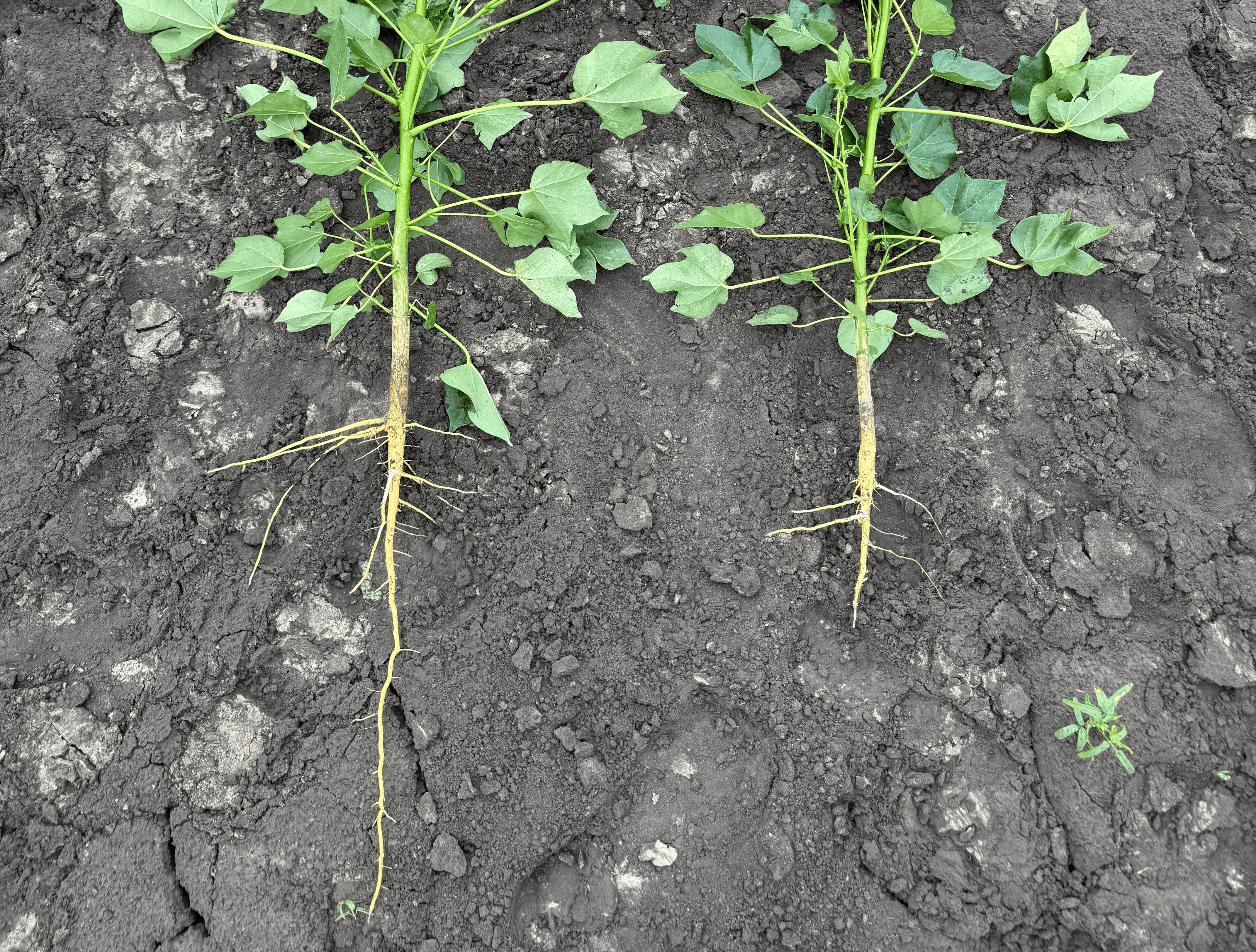
Dryland cotton on Camm Group country near Dalby.
Later that same season, seed cotton weight (pods) was up 61%. A deeper root system pulls moisture and nutrition from further down the profile, which is exactly what a dryland crop needs when there is no irrigation to fall back on. Deeper roots and better root anatomy are consistently tied to higher yield and water-use efficiency in dryland cereals under low water (Li et al., 2024).
Why the difference shows up
Conventional water-soluble fertiliser releases everything at once. Some leaches past the root zone with the first rain, and much of the rest locks up in the soil before the plant can use it. Dissolved phosphate binds fast to iron and aluminium in acid soils, or to calcium in alkaline soils, forming compounds roots cannot access, so only about 10 to 30% of applied phosphorus is taken up in the first year (Penn and Camberato, 2019; Beegle and Durst). Agnano works differently. The phosphorus is pre-complexed into micro and sub-micron particles that are not water-soluble, so rain does not strip them and the soil does not lock them away. It stays at the root zone and releases slowly across the season, matching supply to demand the way controlled-release nutrition is designed to (Shaviv and Mikkelsen, 1993). That is the kind of gain independent reviews of nano-scale fertilisers report, a median of roughly 20 to 30% over conventional products (Kah et al., 2018).
Final Results
The economics follow from the trial itself. The treated strip produced an extra 1.85 bales (0.976t) per hectare over the control. At current cotton prices of around $650 per bale, that is close to $1,200 per hectare in additional revenue. Field trials vary with soil, season and management, so we always recommend running a control strip on your own country before scaling up.
If you want to run a strip trial on your farm this season, get in touch. We will help you set it up so the numbers are yours, not ours.
References
Penn, C.J. and Camberato, J.J. (2019). A critical review on soil chemical processes that control how soil pH affects phosphorus availability to plants. Agriculture, 9(6), 120. https://doi.org/10.3390/agriculture9060120
Beegle, D.B. and Durst, P.T. Managing Phosphorus for Crop Production. Penn State Extension. https://extension.psu.edu/managing-phosphorus-for-crop-production
Shaviv, A. and Mikkelsen, R.L. (1993). Controlled-release fertilizers to increase efficiency of nutrient use and minimize environmental degradation: a review. Fertilizer Research, 35(1-2), 1-12. https://doi.org/10.1007/BF00750215
Kah, M., Kookana, R.S., Gogos, A. and Bucheli, T.D. (2018). A critical evaluation of nanopesticides and nanofertilizers against their conventional analogues. Nature Nanotechnology, 13(8), 677-684. https://doi.org/10.1038/s41565-018-0131-1
Li, P.-F., Ma, B.-L., Wei, X.-F., Guo, S. and Ma, Y.-Q. (2024). Deeper root distribution and optimized root anatomy help improve dryland wheat yield and water use efficiency under low water conditions. Plant and Soil, 501(1-2), 437-454. https://doi.org/10.1007/s11104-024-06526-9

